| Historically
there has never been a "right" to cycle on Dartmoor.
In 1985 The Dartmoor Commons Act afforded access rights to the common areas to Walkers and to Horse Riders. This was not extended to Cyclists, who continued using the Moorland tracks, bridleways, and open areas as they had done for many years previously. This caused few problems, but over the years use of the Moorland for all recreational purposes has increased, and erosion problems have been evident. The DNPA set up a Mangement Strategy - the principal aim being to conserve the Moor for future use, and to control problems of "over-use" before the became too serious. |
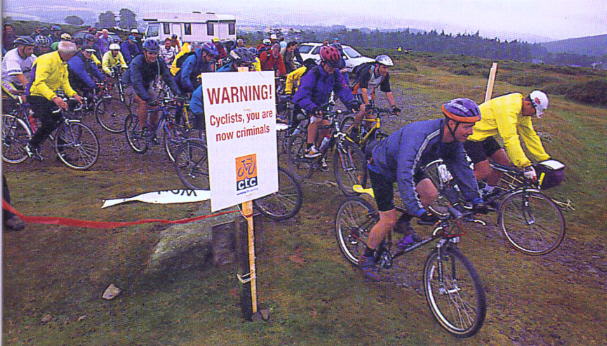
"Criminals" set off for the protest ride near Haytor. |
In 1994 the Dartmoor National Park Authority published the Traffic Management Strategy. In it were 2 strategic policies, specifically policy CY2 was to "Seek a Byelaw to control cyling on common land and access land, so that it can be prevented in sensetive areas and encouraged onto suitable routes. (Significantly - in the 1993 Consultation Document for the strategy, there was no metion of this idea, only the idea to "promote cycling through the development of safe and attractive routes".) On 29th May 1996, DNPA issued a notice of the Byelaw, with a date for objections of 2nd July 1996. On18th June 1996, CTC sent a letter out to over 400 Cylists and associates, telling people about the notice. It is beleived around 150 objections were made to the proposals.
|
In
1997, Cycling representatives from various organisations were invited to
a meeting at the Dartmoor National Park Authority HQ at Parke, Bovey Tracey.
The
meeting was to inform Cyclists about the Management Strategy proposals,
and sought the support of Cyclists for the aims of the strategy. It was
at the early stage that the people present at the meeting were notified
of the proposals to introduce a Byelaw to make Cyling on Open moorland
(Common Land) a criminal offence. |